Mimicry
noun /ˈmɪm.ɪk.ri/ — Close resemblance to another species for protection or predation.
Definition
The action of imitating someone or something, especially as performance. In biology: a close external resemblance of an animal or plant to another species — for protection from predators (Batesian mimicry) or advantage in predation. Mimicry is nature's most successful form of deception.
Beyond the definition
Mimicry is everywhere in nature, and everywhere in human culture. We mimic those we admire, those we fear, those we wish to appease. Language itself is learning through mimicry. We are all, in part, reflections of what we've observed.
Origin & history
Greek: 'mimikos' (imitative). From 'mimos' (actor, imitator). The same root as 'mime', 'mimic', and 'pantomime'.
Example sentences
Illustrative sentences for learning, not verified community posts or sourced quotations.
The stick insect's mimicry is so complete that you can look directly at it and see only a twig.
Children learn language through mimicry before they learn it through understanding.
The company's product was pure mimicry — identical to the original in every feature, available at half the price.
How to use it
This entry uses a noun. Follow the examples for articles and singular or plural forms; not every noun takes “a” or “an.”
Choose “Mimicry” when the meaning fits your context: The action of imitating someone or something, especially as performance. In biology: a close external resemblance of an animal or plant to another species — for protection from predators (Batesian mimicry) or advantage in predation. Mimicry is nature's most successful form of deception.
Synonyms
imitation, camouflage, simulation, copying
Antonyms
originality, distinctiveness
Related words
Mimicry vs camouflage
Camouflage allows an organism to blend in. Mimicry involves evolving to look exactly like another species for protection or predation.
Word in the Wild
See how this word appears in life, language and stories.
Illustrative sentences and imagined stories for learning — not verified sightings, interviews, or sourced quotations.
Illustrative example
Butterflies Gathering On Damp Ground
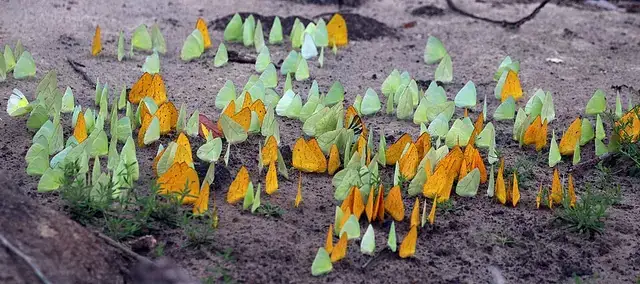
Many butterflies are gathered together on damp ground, their wings displaying patterned colours as they rest and move as one collective unit.
The butterflies display mimicry through their shared patterns and colours, acting as a visual deception. This resemblance helps protect the individuals from predators by making it harder to distinguish a single vulnerable insect from the collective group, a classic example of nature's successful strategy of illusion.
Image credit: Charles J. Sharp · CC BY-SA 4.0 (license)
Resized and converted to WebP; displayed with a fitted crop.
Questions about this word
What does "Mimicry" mean?
Mimicry is noun meaning: Close resemblance to another species for protection or predation.. The action of imitating someone or something, especially as performance. In biology: a close external resemblance of an animal or plant to another species — for protection from predators (Batesian mimicry) or advantage in predation. Mimicry is nature's most successful form of deception.
Where does the word "Mimicry" come from?
Greek: 'mimikos' (imitative). From 'mimos' (actor, imitator). The same root as 'mime', 'mimic', and 'pantomime'.