Adaptation
noun /ˌæd.æpˈteɪ.ʃən/ — A change that makes an organism better suited to its environment.
Definition
The process of change by which an organism or species becomes better suited to its environment over time. Also: a cultural work adapted from another medium. Adaptation is the principle that change is not loss but fitting — the organism and its world coming into better alignment.
Beyond the definition
Every living thing is an adaptation — the result of millions of small adjustments to specific conditions. And every person is an adaptation too: the result of environments they may never fully understand shaping who they become.
Origin & history
Latin: 'adaptare' (to fit, to adjust). From 'ad' (to) + 'aptus' (fit). Related to 'apt', 'aptitude', and 'adopt'. The idea of fitting into something — the organism into its world.
Example sentences
Illustrative sentences for learning, not verified community posts or sourced quotations.
The polar bear's white fur is an adaptation to Arctic conditions — camouflage and insulation in one.
Her move to the city required significant adaptation — the rhythm, the noise, the scale all needed to be learned.
Adaptations are not always improvements. Sometimes the change that helps in one environment costs you in another.
How to use it
This entry uses a noun. Follow the examples for articles and singular or plural forms; not every noun takes “a” or “an.”
Choose “Adaptation” when the meaning fits your context: The process of change by which an organism or species becomes better suited to its environment over time. Also: a cultural work adapted from another medium. Adaptation is the principle that change is not loss but fitting — the organism and its world coming into better alignment.
Synonyms
adjustment, modification, evolution, acclimatisation
Antonyms
rigidity, stagnation, extinction
Related words
Adaptation vs acclimatization
Adaptation is a genetic, long-term evolutionary change. Acclimatization is a short-term, physiological adjustment by an individual to new conditions.
Word in the Wild
See how this word appears in life, language and stories.
Illustrative sentences and imagined stories for learning — not verified sightings, interviews, or sourced quotations.
Fictional scene
Plant Enduring in Marble Crack
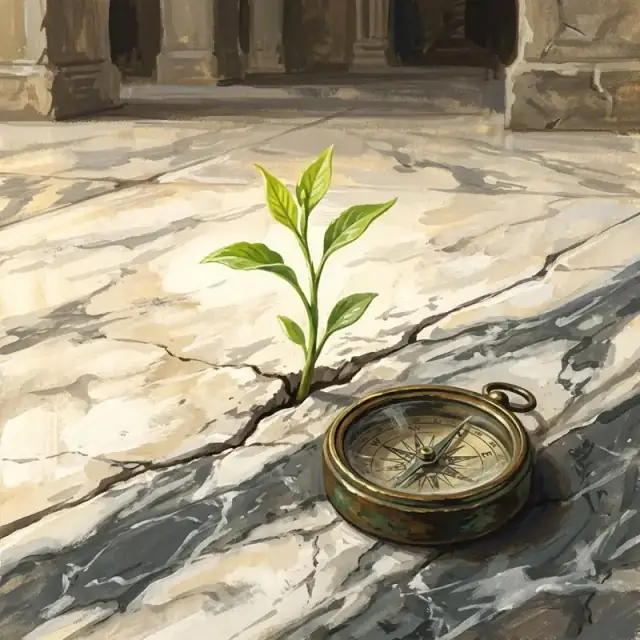
A small, vibrant green shoot growing through a jagged crack in a heavy marble floor, near a discarded, tarnished brass compass.
The plant’s growth in the crack is an adaptation. Its ability to thrive in such a harsh, stony environment shows a process of change where the organism has come into better alignment with its surroundings, proving that change is not necessarily loss, but a better fit.
Image credit: Wordspun · AI-generated conceptual illustration
Questions about this word
What does "Adaptation" mean?
Adaptation is noun meaning: A change that makes an organism better suited to its environment.. The process of change by which an organism or species becomes better suited to its environment over time. Also: a cultural work adapted from another medium. Adaptation is the principle that change is not loss but fitting — the organism and its world coming into better alignment.
Where does the word "Adaptation" come from?
Latin: 'adaptare' (to fit, to adjust). From 'ad' (to) + 'aptus' (fit). Related to 'apt', 'aptitude', and 'adopt'. The idea of fitting into something — the organism into its world.