Evolution
noun /ˌɛv.əˈluː.ʃən/ — The gradual development and change of organisms over generations.
Definition
The gradual development of something; in biology, the process by which different organisms develop from earlier forms through natural selection operating on heritable variation. Evolution is change over time — not towards perfection, but towards fit.
Beyond the definition
Evolution is the most profound idea humanity has produced, because it answers the most fundamental question — where did we come from? — while making clear that we are not finished. We are a moment in a process that has no goal, no end.
Origin & history
Latin: 'evolvere' (to unroll, to unfold). From 'e' (out) + 'volvere' (to roll). Darwin published 'On the Origin of Species' in 1859, transforming the word from its general sense of 'unfolding' to its specific biological meaning.
Example sentences
Illustrative sentences for learning, not verified community posts or sourced quotations.
Evolution is not progress toward a goal. It is adaptation to conditions — and conditions change.
The evolution of language mirrors biological evolution: variation, selection, inheritance, drift.
She had undergone an evolution in her thinking that she couldn't have predicted five years earlier.
How to use it
This entry uses a noun. Follow the examples for articles and singular or plural forms; not every noun takes “a” or “an.”
Choose “Evolution” when the meaning fits your context: The gradual development of something; in biology, the process by which different organisms develop from earlier forms through natural selection operating on heritable variation. Evolution is change over time — not towards perfection, but towards fit.
Synonyms
development, progression, change, natural selection
Antonyms
stasis, fixity, creation
Related words
Evolution vs adaptation
Evolution is the overall process of change in species over generations. Adaptation is a specific feature that helps an organism survive within that evolution.
Word in the Wild
See how this word appears in life, language and stories.
Illustrative sentences and imagined stories for learning — not verified sightings, interviews, or sourced quotations.
Fictional scene
Layered Time of Ruins and City
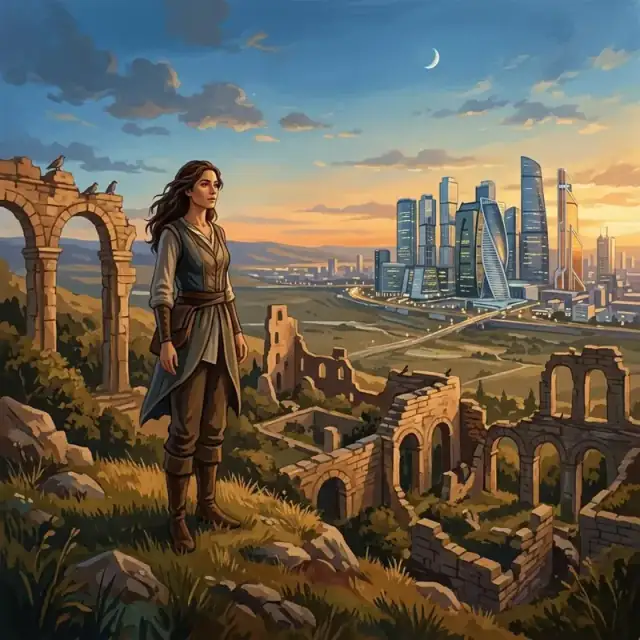
An adult looks over a landscape showing crumbling ancient ruins in the foreground and a modern city of steel in the distance.
The landscape illustrates evolution, representing change over time. The transition from crumbling ancient ruins to modern steel structures is not a move toward perfection, but a process of development where forms emerge from earlier versions, showing the gradual, persistent unfolding of human life and architecture.
Image credit: Wordspun · AI-generated conceptual illustration
Questions about this word
What does "Evolution" mean?
Evolution is noun meaning: The gradual development and change of organisms over generations.. The gradual development of something; in biology, the process by which different organisms develop from earlier forms through natural selection operating on heritable variation. Evolution is change over time — not towards perfection, but towards fit.
Where does the word "Evolution" come from?
Latin: 'evolvere' (to unroll, to unfold). From 'e' (out) + 'volvere' (to roll). Darwin published 'On the Origin of Species' in 1859, transforming the word from its general sense of 'unfolding' to its specific biological meaning.