Vestige
noun /ˈvɛstɪdʒ/ — A trace or remnant of something that has otherwise passed.
Definition
A trace of something that is disappearing or no longer exists; a small remaining amount of something that was once present in greater quantity.
Beyond the definition
Vestiges are moving precisely because they are not the thing itself but its footprint. The ruined monastery, the abandoned accent, the reflex that evolved for a world that no longer exists — vestiges remind us that history does not entirely end, it fades. The past as residue.
Origin & history
From Latin vestigium (footprint, track). A vestige is literally a footprint — the mark left behind by something that has passed and cannot be called back.
Example sentences
Illustrative sentences for learning, not verified community posts or sourced quotations.
The only vestige of the old railway line was a slightly sunken line through the meadow.
He retained a vestige of his grandmother's accent — a softening of vowels she had brought from elsewhere.
The institution was a vestige of an era when such things had made sense.
How to use it
This entry uses a noun. Follow the examples for articles and singular or plural forms; not every noun takes “a” or “an.”
Choose “Vestige” when the meaning fits your context: A trace of something that is disappearing or no longer exists; a small remaining amount of something that was once present in greater quantity.
Synonyms
Antonyms
presence, fullness, completeness
Related words
Vestige vs remnant
A vestige is specifically a trace or footprint — something that barely remains, suggesting near-total disappearance. The word itself is poetic: a vestige implies the thing is almost gone. A remnant is more neutral: a remaining portion, often physically substantial. The last vestige of an empire is a ruined arch; a remnant of fabric is a useful offcut. Vestige carries elegiac weight; remnant is practical.
Word in the Wild
See how this word appears in life, language and stories.
Illustrative sentences and imagined stories for learning — not verified sightings, interviews, or sourced quotations.
Fictional scene
Old Chair Reclaimed by Forest
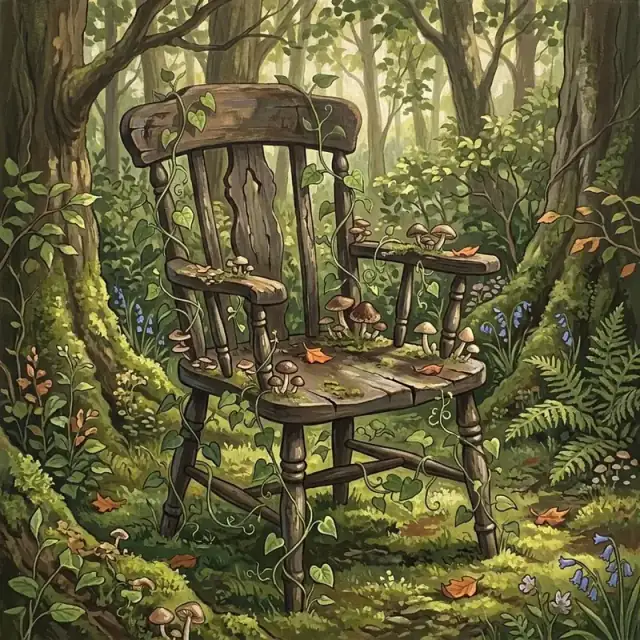
A beautiful, old wooden chair is slowly being reclaimed by the forest floor, with vines wrapping around its legs.
The decaying chair is a vestige—a small, remaining trace of a human life that was once present in greater quantity. The vines and mushrooms show the chair disappearing into the earth, marking the remnants of something no longer in active use.
Image credit: Wordspun · AI-generated conceptual illustration
Questions about this word
What does "Vestige" mean?
Vestige is noun meaning: A trace or remnant of something that has otherwise passed.. A trace of something that is disappearing or no longer exists; a small remaining amount of something that was once present in greater quantity.
Where does the word "Vestige" come from?
From Latin vestigium (footprint, track). A vestige is literally a footprint — the mark left behind by something that has passed and cannot be called back.