Palimpsest
noun /ˈpalɪm(p)sɛst/ — History layered over itself — the past showing through the present.
Definition
A manuscript or piece of writing on which later writing has been superimposed on erased earlier writing; more broadly, anything that carries the marks of earlier forms beneath a later surface.
Beyond the definition
Palimpsest is the word for historical layering — the medieval city that hides a Roman one below it, the face of an old person that still holds the face of the child. Time does not erase what came before; it writes over it. The earlier text still speaks if you know how to read through the new.
Origin & history
From Greek palimpsestos (scraped clean again), from palin (again) + psestos (scraped). Medieval manuscripts were expensive; the parchment was reused by scraping off old ink. But the old writing often remained visible beneath the new.
Example sentences
Illustrative sentences for learning, not verified community posts or sourced quotations.
London is a palimpsest — Roman streets under medieval streets under Georgian ones.
Her face was a palimpsest of every feeling she had had for thirty years.
He read the letter as a palimpsest — what it said on the surface less important than what showed through.
Synonyms
layered history, overwriting, historical accumulation
Antonyms
blank slate, tabula rasa, new beginning
Related words
Word in the Wild
See how this word appears in life, language and stories.
Illustrative sentences and imagined stories for learning — not verified sightings, interviews, or sourced quotations.
Fictional scene
Ancient tablet with geometric shapes
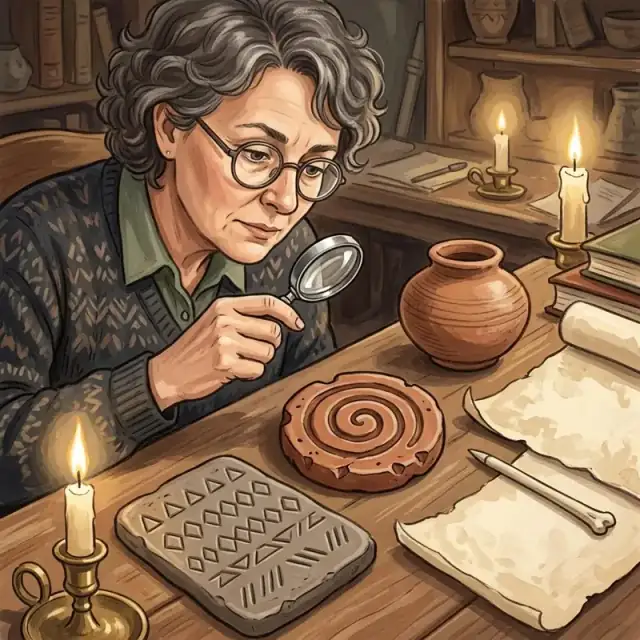
An archaeologist examines a tablet bearing repeated geometric shapes and an abstract seal, lit by candlelight on a desk.
The tablet acts as a palimpsest—an object that carries the marks of earlier forms beneath a later surface. The archaeologist’s study is an attempt to peel back these layers and reveal the history hidden underneath the current, visible markings.
Image credit: Wordspun · AI-generated conceptual illustration