Umber
noun / adjective /ˈʌm.bər/ — A natural brown earth pigment
Definition
A natural brown to dark brown pigment — made from iron oxide and manganese oxide found in clay. Raw umber is cool and greenish-brown; burnt umber is deeper and redder.
Beyond the definition
The colour of earth and honesty. Umber is the brown of things that have been in the ground — soil, bark, shadow. It carries no pretension.
Origin & history
Possibly from Latin 'umbra' (shadow) or from Umbria, the Italian region where the pigment was historically sourced. One of the oldest pigments known — found in prehistoric cave paintings.
Example sentences
Illustrative sentences for learning, not verified community posts or sourced quotations.
Rembrandt built his shadows from umber — the warmth of it gave his darkness life.
The muddy field had gone umber after the rain — the colour of earth given back to itself.
Raw umber in the painting gave the shadow its slight coolness. Burnt umber would have been warmer.
Synonyms
brown, earth-brown, sienna, raw umber, burnt umber
Related words
- ochre
- sable
- chiaroscuro
- colour-light
Word in the Wild
See how this word appears in life, language and stories.
Illustrative sentences and imagined stories for learning — not verified sightings, interviews, or sourced quotations.
Fictional scene
Earthy Tones of Natural Clay
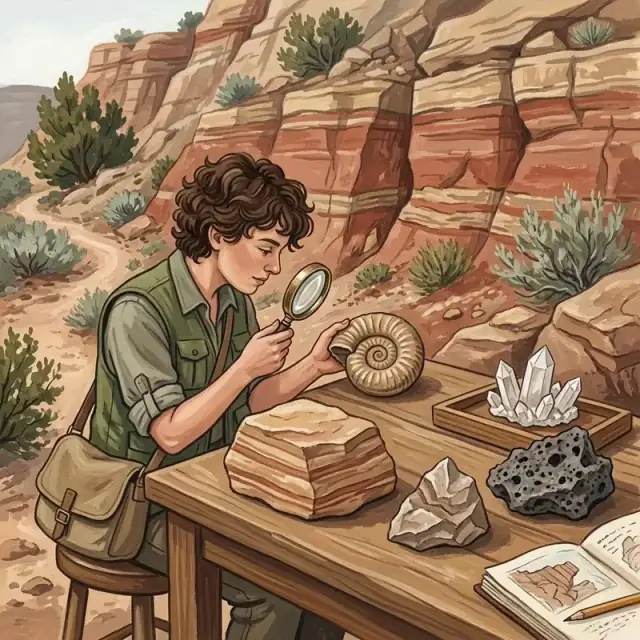
A naturalist’s workbench is arranged with layered sedimentary stone, a spiral fossil, and various earth-toned rocks alongside a magnifying glass.
Umber is an earthy brown pigment derived from iron and manganese clay. The natural stones on the workbench—specifically the earthy, brownish sedimentary and volcanic rocks—serve as a literal source and visual representation of umber's raw, natural origins in the earth.
Image credit: Wordspun · AI-generated conceptual illustration