Sonder
noun /ˈsɒndər/ — The sudden awareness that everyone's life is as vivid as yours.
Definition
The realization that each passerby has a life as vivid, complex, and real as your own — full of ambitions, routines, heartbreaks, and joy that you'll never witness.
Beyond the definition
Coined by John Koenig for The Dictionary of Obscure Sorrows. It's the word for that moment on a busy street when the crowd suddenly stops being background noise and becomes full of individuals. Quietly humbling.
Origin & history
A modern word coined by John Koenig for The Dictionary of Obscure Sorrows. His original entry describes recognizing that each passerby has a life as vivid and complex as your own. It is a deliberate coinage, not an inherited English word.
Example sentences
Illustrative sentences for learning, not verified community posts or sourced quotations.
Watching the airport crowd, he was overcome by sonder — all those lives intersecting.
Sonder hit her in the grocery store, looking at the woman two lanes over.
There's a kind of sonder that comes from reading old diaries — other lives, fully lived.
How to use it
Sonder is John Koenig’s coined noun for recognizing the complexity of other people’s lives. Explain it on first use for readers unfamiliar with The Dictionary of Obscure Sorrows; it is not a clinical diagnosis.
Illustrative example: “Watching the commuters, she felt sonder as she imagined the lives continuing beyond the station.”
Synonyms
awareness, empathy, consciousness of others
Antonyms
self-absorption, obliviousness
Related words
Sonder vs empathy
Sonder names the recognition that other people have vivid, complex lives of their own. Empathy is the ability to understand or share another person's feelings by imagining their situation. Sonder can prompt empathy, but recognizing that someone has a full life is not the same as understanding what they feel.
Compare this word
Word in the Wild
See how this word appears in life, language and stories.
Illustrative sentences and imagined stories for learning — not verified sightings, interviews, or sourced quotations.
Fictional scene
Not just background characters
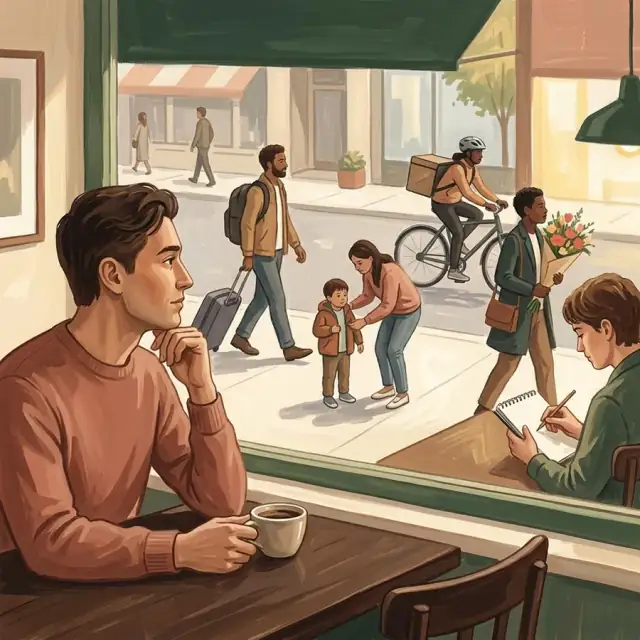
From a café window, one person notices a traveller, a parent, a cyclist and other people absorbed in their separate days. For a moment, the passing crowd stops feeling like background.
The luggage, flowers and everyday tasks are prompts to imagine lives continuing beyond this one glimpse. The picture cannot reveal those people's private stories. It illustrates the shift in attention behind sonder: recognising that strangers have their own full lives, even when we know almost nothing about them.
Image credit: Wordspun · AI-generated illustration