Sisyphean
adjective /ˌsɪsɪˈfiːən/ — Endlessly futile — effort that never reaches its goal.
Definition
Of or relating to Sisyphus; denoting a task that can never be completed; endlessly and futilely laborious.
Beyond the definition
Sisyphus was condemned to roll a boulder up a hill for eternity — it always rolls back before he reaches the top. Sisyphean describes any task with that specific quality: effort that never resolves, work that always regenerates, a condition that cannot be fixed. Albert Camus wrote that we must imagine Sisyphus happy — the absurdist's answer to futility.
Origin & history
From Sisyphus, king of Corinth, condemned by Zeus to roll a boulder up a hill for eternity as punishment for his craftiness and deceitfulness. The myth appears in Homer.
Example sentences
Illustrative sentences for learning, not verified community posts or sourced quotations.
Keeping the inbox at zero felt Sisyphean — every cleared email was replaced by three more.
He'd been locked in a Sisyphean negotiation for six months, the same points cycling endlessly.
Camus argued the Sisyphean condition is the human condition — and that clarity about this is a form of freedom.
Synonyms
futile, endless, unwinnable, Herculean (ironically), thankless
Antonyms
conclusive, rewarding, achievable
Related words
Word in the Wild
See how this word appears in life, language and stories.
Illustrative sentences and imagined stories for learning — not verified sightings, interviews, or sourced quotations.
Fictional scene
Guardian at the maze entrance
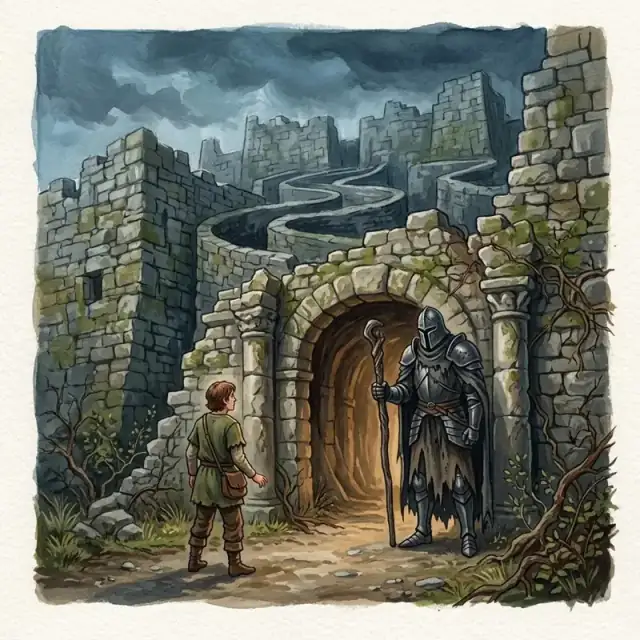
An adult stands before a tall stone-walled maze, with an imposing guardian figure waiting at the entrance of the entrance.
The task of navigating such a maze feels sisyphean—a task that could be endless and futilely laborious. It captures the struggle of facing a difficulty that seems impossible to complete, regardless of the effort invested by the individual.
Image credit: Wordspun · AI-generated conceptual illustration