Revolution
noun /ˌrɛv.əˈluː.ʃən/ — A complete overthrow of an established system; a dramatic and transformative change.
Definition
A forcible overthrow of a government or social order in favour of a new system. Also: a dramatic and wide-reaching change in conditions, attitudes, or operation. The revolution turns things over — the word comes from rotating, revolving, returning.
Beyond the definition
Every revolution promises everything and arrives at something more complicated. The ideas are simple. The implementation never is. But without revolutions, the world would not move. It would only accumulate.
Origin & history
Latin: 'revolutio' (a turn around). From 'revolvere' (to roll back). The astronomical sense — a planet's revolution around the sun — came first; the political sense followed in the 17th century.
Example sentences
Illustrative sentences for learning, not verified community posts or sourced quotations.
The American Revolution gave the world a document, and a question: whether any of it was actually true.
The industrial revolution was the most total revolution in human experience since agriculture.
Some revolutions happen quietly: the woman who changed her mind, the language that shifted.
How to use it
This entry uses a noun. Follow the examples for articles and singular or plural forms; not every noun takes “a” or “an.”
Choose “Revolution” when the meaning fits your context: A forcible overthrow of a government or social order in favour of a new system. Also: a dramatic and wide-reaching change in conditions, attitudes, or operation. The revolution turns things over — the word comes from rotating, revolving, returning.
Synonyms
uprising, transformation, overthrow, sea change
Antonyms
conservation, stability, status quo
Related words
Revolution vs rebellion
While both involve challenging authority, a revolution aims to fundamentally replace the entire power structure. A rebellion is often a more localized or specific resistance that may not seek to overhaul the system entirely.
Word in the Wild
See how this word appears in life, language and stories.
Illustrative sentences and imagined stories for learning — not verified sightings, interviews, or sourced quotations.
Fictional scene
Time Layered in Landscape
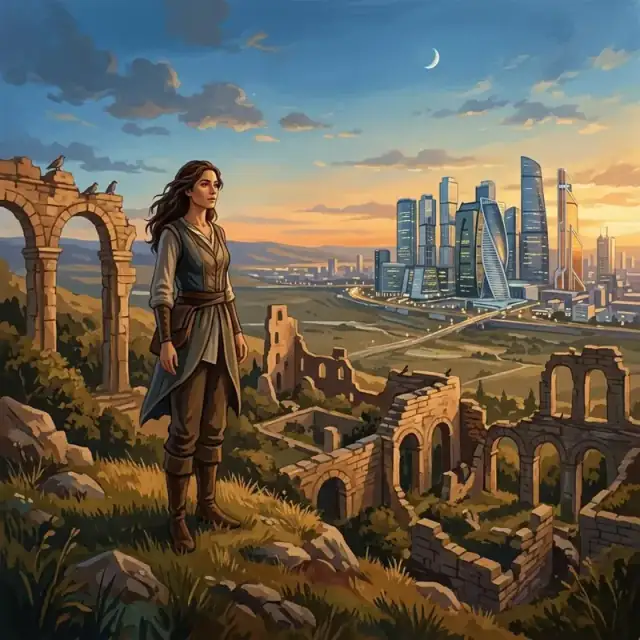
An adult stands on a hill overlooking crumbling ruins in the foreground and a modern city in the distance.
The dramatic change from the ancient ruins to the modern glass city represents a revolution—a wide-reaching transformation that has 'turned over' the old social order in favor of a new one.
Image credit: Wordspun · AI-generated conceptual illustration
Questions about this word
What does "Revolution" mean?
Revolution is noun meaning: A complete overthrow of an established system; a dramatic and transformative change.. A forcible overthrow of a government or social order in favour of a new system. Also: a dramatic and wide-reaching change in conditions, attitudes, or operation. The revolution turns things over — the word comes from rotating, revolving, returning.
Where does the word "Revolution" come from?
Latin: 'revolutio' (a turn around). From 'revolvere' (to roll back). The astronomical sense — a planet's revolution around the sun — came first; the political sense followed in the 17th century.