Placate
verb /ˈpleɪ.keɪt/ — To make someone less angry or hostile.
Definition
To make a person less angry, upset, or hostile by conciliation or by conceding something; to appease or pacify.
Beyond the definition
Placate is the diplomatic verb — the word for what you do when someone is upset and you need to bring the temperature down. It's a practical kindness, but it can also be a form of avoidance: placating without resolving. The word knows the difference between easing tension and addressing its cause.
Origin & history
From Latin placare ('to appease, to soothe'), related to placere ('to please'). The root of 'placid' and 'complacent' — the whole family tends toward calm.
Example sentences
Illustrative sentences for learning, not verified community posts or sourced quotations.
He brought flowers, hoping to placate her after the argument.
The company issued a statement designed to placate its investors, though few were convinced.
How to use it
This entry uses a verb. Follow the examples for tense and any objects or prepositions it needs.
Choose “Placate” when the meaning fits your context: To make a person less angry, upset, or hostile by conciliation or by conceding something; to appease or pacify.
Synonyms
appease, pacify, mollify, conciliate, soothe
Antonyms
provoke, agitate, antagonize, inflame
Related words
- assuage
- mollify
- conciliate
- calm
Placate vs appease
Appease often implies giving concessions or making sacrifices to satisfy someone's demands — sometimes at cost to yourself or others. Placate is more about calming the emotional state without necessarily yielding: the gesture, the tone, the acknowledgment. Placating can be done through warmth and care; appeasing often involves giving something up. In international relations, appeasement has a cautionary historical meaning; placating carries no such weight.
Compare this word
Word in the Wild
See how this word appears in life, language and stories.
Illustrative sentences and imagined stories for learning — not verified sightings, interviews, or sourced quotations.
Fictional scene
Careful restoration of damaged things
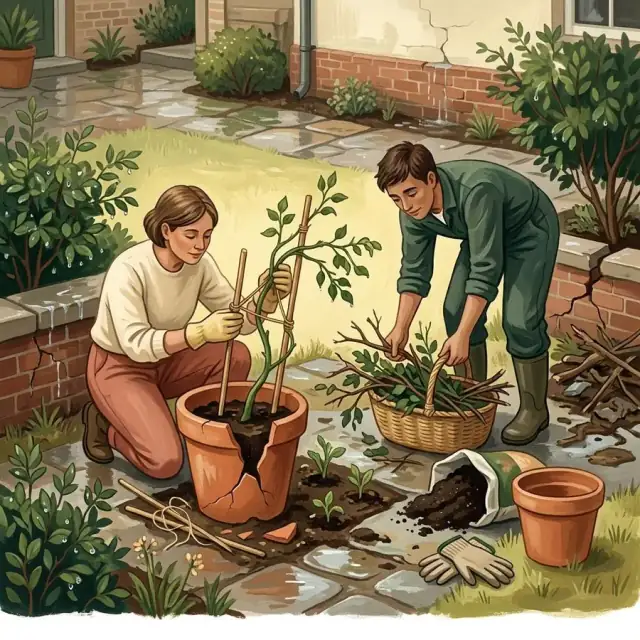
Two neighbors work together to stake a bent plant, addressing the damage caused by the storm with deliberate, soothing physical actions.
By attending to the damaged plant, the neighbors are working to pacify the environment's state of disarray. This illustrates the act of placating, where a gentle, conciliatory effort is made to reduce hostility or disorder in a troubled situation.
Image credit: Wordspun · AI-generated illustration
Questions about this word
What does "Placate" mean?
Placate is verb meaning: To make someone less angry or hostile.. To make a person less angry, upset, or hostile by conciliation or by conceding something; to appease or pacify.
Where does the word "Placate" come from?
From Latin placare ('to appease, to soothe'), related to placere ('to please'). The root of 'placid' and 'complacent' — the whole family tends toward calm.