Jamais Vu
idiom / noun /ˌʒæm.eɪ ˈvuː/ — Experiencing the familiar as if for the first time
Definition
The opposite of déjà vu: the strange sensation that something completely familiar — a word, a face, a place — suddenly feels entirely new, alien, and unrecognised. Jamais vu is the familiar made strange.
Beyond the definition
Jamais vu is the most disorienting experience in ordinary life — looking at your own name until it becomes a meaningless shape, or meeting someone you've known for years and feeling like a stranger to them. It questions whether familiarity is real.
Origin & history
French: 'never seen'. The psychological opposite of déjà vu — studied in neuropsychology as a disruption of memory and recognition processes. Less common and less discussed than déjà vu.
Example sentences
Illustrative sentences for learning, not verified community posts or sourced quotations.
She stared at the word 'tomorrow' until jamais vu set in — it looked like nonsense.
Jamais vu is déjà vu's stranger, quieter cousin. Less romantic, more unsettling.
He had a moment of jamais vu looking at his own hands — whose are these?
How to use it
Follow this entry’s examples for grammatical form and sentence placement.
Choose “Jamais Vu” when the meaning fits your context: The opposite of déjà vu: the strange sensation that something completely familiar — a word, a face, a place — suddenly feels entirely new, alien, and unrecognised. Jamais vu is the familiar made strange.
Synonyms
defamiliarisation, cognitive dissociation, unfamiliarity with the known
Antonyms
déjà vu, recognition, familiarity
Related words
Jamais Vu vs confusion
Confusion is a lack of understanding. 'Jamais vu' is the exact opposite of déjà vu: looking at something perfectly familiar and feeling like you've never seen it before.
Word in the Wild
See how this word appears in life, language and stories.
Illustrative sentences and imagined stories for learning — not verified sightings, interviews, or sourced quotations.
Fictional scene
Adult Sitting in Vast Empty Room
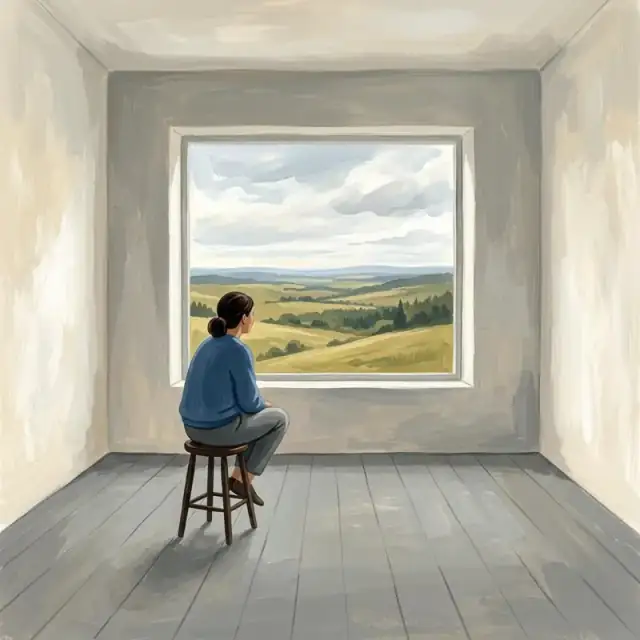
An adult sits alone in a minimal room, with a large window showing a vast landscape in the background.
The total absence of familiar objects makes this space feel strange and alien. Jamais vu describes this paradoxical sensation where a place that should be understood suddenly appears entirely unrecognised or entirely new, despite having been seen before.
Image credit: Wordspun · AI-generated conceptual illustration
Questions about this word
What does "Jamais Vu" mean?
Jamais Vu is idiom / noun meaning: Experiencing the familiar as if for the first time. The opposite of déjà vu: the strange sensation that something completely familiar — a word, a face, a place — suddenly feels entirely new, alien, and unrecognised. Jamais vu is the familiar made strange.
Where does the word "Jamais Vu" come from?
French: 'never seen'. The psychological opposite of déjà vu — studied in neuropsychology as a disruption of memory and recognition processes. Less common and less discussed than déjà vu.