Dystopia
noun /dɪsˈtəʊ.pi.ə/ — An imagined society where everything is unpleasant, oppressive, or wrong.
Definition
An imagined state or society in which there is great suffering or injustice, typically characterised by totalitarian government, environmental disaster, or technological oppression. The opposite of utopia.
Beyond the definition
The dystopia genre is so popular because it takes present anxieties and extends them — what if this tendency, followed to its conclusion, produced that world? Dystopia is always about now, written as if about then.
Origin & history
Greek: 'dys' (bad, difficult) + 'topos' (place). Coined as the opposite of 'utopia'. The genre crystallised in the 20th century: Zamyatin's 'We', Huxley's 'Brave New World', Orwell's '1984'.
Example sentences
Illustrative sentences for learning, not verified community posts or sourced quotations.
The novel's dystopia felt less like speculation and more like extrapolation — too close to familiar patterns.
Every dystopia is someone's utopia — which is the point.
She lived in a country that wasn't quite dystopian but was moving in that direction with impressive efficiency.
How to use it
This entry uses a noun. Follow the examples for articles and singular or plural forms; not every noun takes “a” or “an.”
Choose “Dystopia” when the meaning fits your context: An imagined state or society in which there is great suffering or injustice, typically characterised by totalitarian government, environmental disaster, or technological oppression. The opposite of utopia.
Synonyms
anti-utopia, dark future, hellscape
Antonyms
Related words
Dystopia vs utopia
Dystopia focuses on the catastrophic results of societal collapse or total control. Utopia represents the aspirational inverse, emphasizing a harmonious and perfected existence.
Word in the Wild
See how this word appears in life, language and stories.
Illustrative sentences and imagined stories for learning — not verified sightings, interviews, or sourced quotations.
Fictional scene
Staircase Representing Social Hierarchy
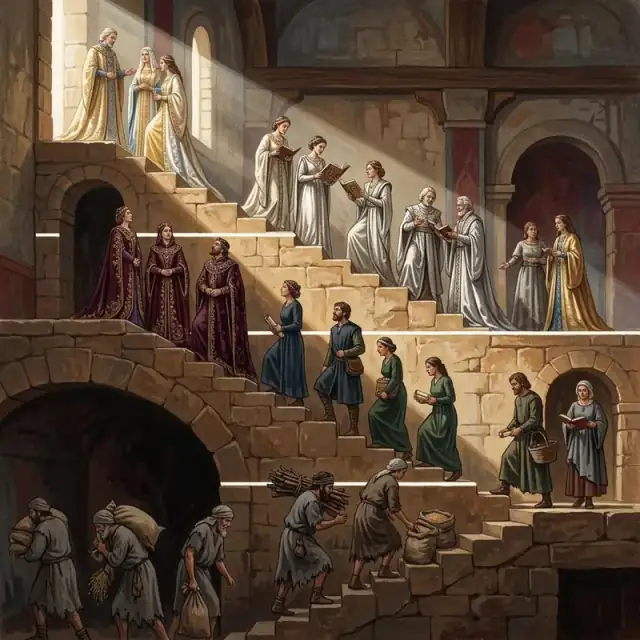
A large staircase shows people at different levels dressed in distinct, hierarchical styles of clothing.
The rigid hierarchy of the staircase, if taken as a fixed social structure, represents the foundation of a dystopia where injustice is built into the framework of the society itself.
Image credit: Wordspun · AI-generated conceptual illustration
Questions about this word
What does "Dystopia" mean?
Dystopia is noun meaning: An imagined society where everything is unpleasant, oppressive, or wrong.. An imagined state or society in which there is great suffering or injustice, typically characterised by totalitarian government, environmental disaster, or technological oppression. The opposite of utopia.
Where does the word "Dystopia" come from?
Greek: 'dys' (bad, difficult) + 'topos' (place). Coined as the opposite of 'utopia'. The genre crystallised in the 20th century: Zamyatin's 'We', Huxley's 'Brave New World', Orwell's '1984'.