Allegory
noun /ˈæləɡəri/ — A story that is secretly about something else entirely.
Definition
A story, poem, or picture that can be interpreted to reveal a hidden meaning, typically a moral or political one; using characters and events to represent abstract ideas.
Beyond the definition
Allegory allows writers to say things that can't be said directly. Orwell's Animal Farm is about pigs — and it's about Soviet totalitarianism. Plato's cave is about shadows on a wall — and it's about the nature of human knowledge. Great allegories work on both levels simultaneously.
Origin & history
From Greek allegoria — description of one thing under the image of another (allos 'other' + agoreuein 'to speak in the assembly').
Example sentences
Illustrative sentences for learning, not verified community posts or sourced quotations.
The novel worked as both a gripping narrative and a sustained allegory about grief.
All fairy tales are allegories — the forest is never just a forest.
He was too literal-minded for allegory; he insisted on taking everything at face value.
Synonyms
parable, fable, metaphor, symbolism, extended metaphor
Antonyms
literal, direct, factual
Related words
Allegory vs metaphor
An allegory is an extended narrative where characters and events symbolize a hidden meaning. A metaphor is a concise figure of speech that equates two unrelated things to highlight a single shared trait.
Compare this word
Word in the Wild
See how this word appears in life, language and stories.
Illustrative sentences and imagined stories for learning — not verified sightings, interviews, or sourced quotations.
Fictional scene
Guardian before a complex maze
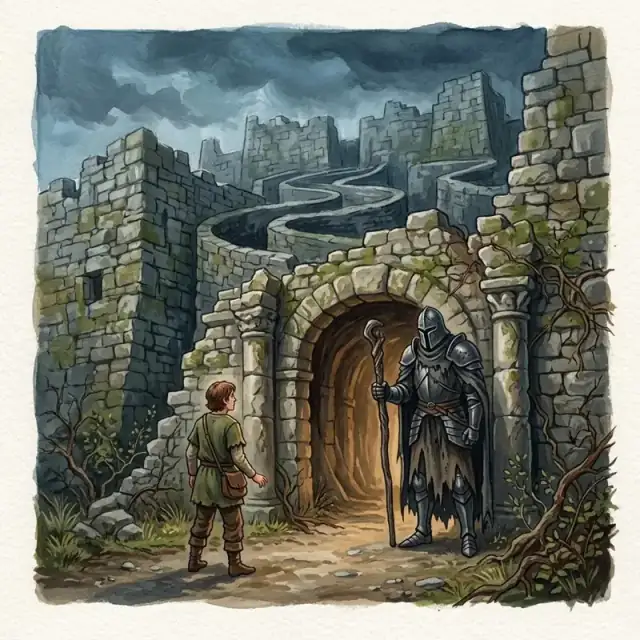
An adult stands before a complex, stone-walled maze, with an imposing guardian figure at the entrance.
The maze and the guardian serve as a story that can be interpreted to reveal a hidden moral, using the characters and the setting to represent a complex, life-long trial.
Image credit: Wordspun · AI-generated conceptual illustration