Spore
noun /spɔː/ — A tiny reproductive unit capable of becoming a new organism.
Definition
A minute reproductive body capable of developing into a new organism without sexual fusion. Spores are produced by fungi, ferns, mosses, and bacteria — tiny, durable, designed to travel and persist through harsh conditions.
Beyond the definition
The spore is life at its most minimal and most patient. Too small to be seen, capable of surviving decades of dormancy, able to travel hundreds of miles on the wind — and then, in the right conditions, becoming something entirely new.
Origin & history
Greek: 'spora' (sowing, seed). From 'speirein' (to scatter, to sow). Related to 'sporadic' — occasional, scattered, like spores released into the air.
Example sentences
Illustrative sentences for learning, not verified community posts or sourced quotations.
A single puffball mushroom can release seven trillion spores in its lifetime.
Ideas spread like spores — invisible, drifting, landing in unexpected places, growing where conditions allow.
The spore is proof that life doesn't need much. Just the essential information and a condition of possibility.
How to use it
This entry uses a noun. Follow the examples for articles and singular or plural forms; not every noun takes “a” or “an.”
Choose “Spore” when the meaning fits your context: A minute reproductive body capable of developing into a new organism without sexual fusion. Spores are produced by fungi, ferns, mosses, and bacteria — tiny, durable, designed to travel and persist through harsh conditions.
Synonyms
seed, reproductive unit, propagule
Related words
Spore vs seed
A seed contains an embryo and food reserves. A spore is a single-celled reproductive unit that requires no food reserves to disperse.
Word in the Wild
See how this word appears in life, language and stories.
Illustrative sentences and imagined stories for learning — not verified sightings, interviews, or sourced quotations.
Fictional scene
Sunlight and Moonlight on Tree
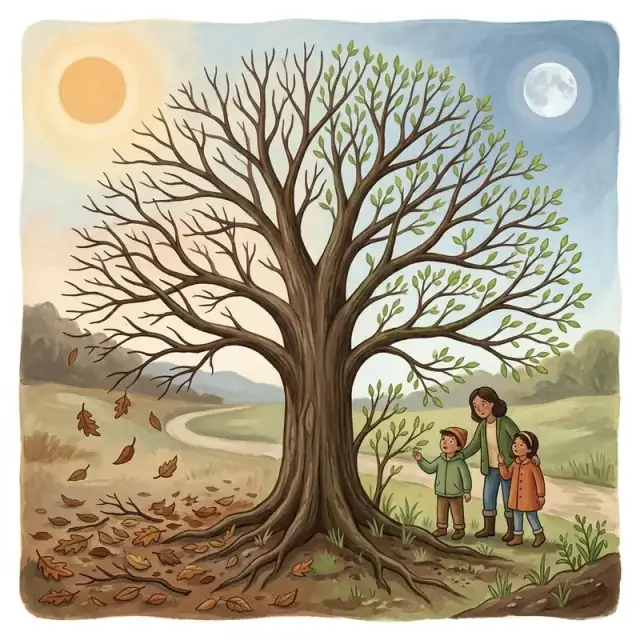
A tree with fallen brown leaves, bare twigs, and budding leaves under a soft, combined circle of sunlight and moonlight in the sky.
The conceptual cycle of the tree serves as an analogy for the spore. Just as a spore is a tiny, durable reproductive body designed to persist through harsh changes, the tree's cycle represents the enduring nature of life, capable of surviving and regenerating through different conditions.
Image credit: Wordspun · AI-generated conceptual illustration
Questions about this word
What does "Spore" mean?
Spore is noun meaning: A tiny reproductive unit capable of becoming a new organism.. A minute reproductive body capable of developing into a new organism without sexual fusion. Spores are produced by fungi, ferns, mosses, and bacteria — tiny, durable, designed to travel and persist through harsh conditions.
Where does the word "Spore" come from?
Greek: 'spora' (sowing, seed). From 'speirein' (to scatter, to sow). Related to 'sporadic' — occasional, scattered, like spores released into the air.