Phosphorescence
noun /ˌfɒsfəˈrɛsəns/ — Light that glows without burning — cold, alive, mysterious.
Definition
Light emitted by a substance without combustion or perceptible heat; the emission of radiation in the absence of obvious heat, especially the glow produced by living organisms in the dark.
Beyond the definition
Phosphorescence names one of nature's most genuinely uncanny gifts: the living sea that glows blue at night, the fox fires in old wood, the bioluminescent organisms that light their own path in total darkness. The writer Rebecca Solnit used it as a metaphor for people who carry their own light in the dark.
Origin & history
From Greek phosphoros 'light-bearing' (from phos 'light' + pheros 'bearing'). First recorded in English in the 17th century to describe the 'cold' light of the sea.
Example sentences
Illustrative sentences for learning, not verified community posts or sourced quotations.
The phosphorescence of the bay lit their hands blue every time they lifted them from the water.
She had a phosphorescence about her — a quiet brightness that didn't depend on the room's light.
The rotting wood glowed with phosphorescence in the dark forest — ancient and eerie.
Synonyms
bioluminescence, glow, luminescence, cold light, foxfire
Antonyms
darkness, opacity
Related words
Word in the Wild
See how this word appears in life, language and stories.
Illustrative sentences and imagined stories for learning — not verified sightings, interviews, or sourced quotations.
Illustrative example
Drifting in the water
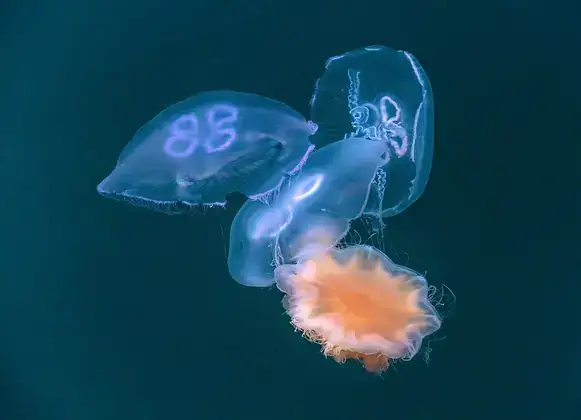
Several jellyfish drift together in the dark, deep water, their forms faintly glowing under the surface.
The internal light produced by the jellyfish without fire or heat is the essence of phosphorescence. It illustrates how living organisms can glow with their own energy in the dark, existing as points of light in their natural environment.
Image credit: W.carter · CC BY-SA 4.0 (license)
Resized and converted to WebP; displayed with a fitted crop.