Mutualism
noun /ˈmjuː.tʃu.ə.lɪ.z(ə)m/ — A relationship where both parties benefit from the interaction.
Definition
A relationship between two organisms in which each benefits from the interaction. Mutualism is symbiosis at its most cooperative — the bee needs the flower's nectar; the flower needs the bee's pollination. Both win.
Beyond the definition
The best human relationships are mutualistic. Both parties richer for the exchange, neither diminished. Mutualism is the biological word for what we mean when we say a friendship feeds both people.
Origin & history
Latin: 'mutuus' (mutual, shared). The biological sense was formalised in the 19th century by Pierre-Joseph van Beneden, who distinguished mutualism from parasitism and commensalism.
Example sentences
Illustrative sentences for learning, not verified community posts or sourced quotations.
The relationship between mycorrhizal fungi and trees is mutualism: the fungi take sugars; the tree gains water and nutrients.
Their creative partnership was pure mutualism — each making the other's work better without sacrificing their own.
Political alliances based on mutualism tend to be more durable than those based on shared enemies.
How to use it
This entry uses a noun. Follow the examples for articles and singular or plural forms; not every noun takes “a” or “an.”
Choose “Mutualism” when the meaning fits your context: A relationship between two organisms in which each benefits from the interaction. Mutualism is symbiosis at its most cooperative — the bee needs the flower's nectar; the flower needs the bee's pollination. Both win.
Synonyms
symbiosis, cooperation, reciprocity, partnership
Antonyms
parasitism, exploitation, competition
Related words
Mutualism vs parasitism
Mutualism is a relationship where both parties benefit. Parasitism describes a relationship where one organism thrives at the direct expense of another.
Word in the Wild
See how this word appears in life, language and stories.
Illustrative sentences and imagined stories for learning — not verified sightings, interviews, or sourced quotations.
Illustrative example
Colourful Birds Gathering Beside Water
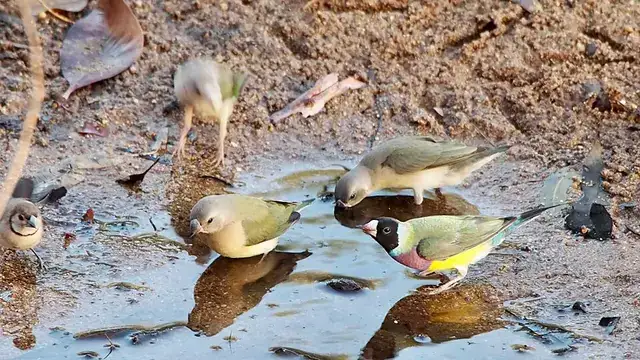
A group of colourful Gouldian finches gathers beside a small pool, drinking and interacting in the warm, clear, sunlit environment.
The finches gathered around water illustrate mutualism, where the survival of the group is linked to their interaction with the shared habitat. The water provides for the birds, who in turn maintain the health of the surroundings, showing how each benefits from the stable, cooperative arrangement.
Image credit: Swimpanzee · CC BY 4.0 (license)
Resized and converted to WebP; displayed with a fitted crop.
Questions about this word
What does "Mutualism" mean?
Mutualism is noun meaning: A relationship where both parties benefit from the interaction.. A relationship between two organisms in which each benefits from the interaction. Mutualism is symbiosis at its most cooperative — the bee needs the flower's nectar; the flower needs the bee's pollination. Both win.
Where does the word "Mutualism" come from?
Latin: 'mutuus' (mutual, shared). The biological sense was formalised in the 19th century by Pierre-Joseph van Beneden, who distinguished mutualism from parasitism and commensalism.