Medieval
adjective /ˌmɛd.iˈiː.vəl/ — Relating to the Middle Ages; archaically old-fashioned.
Definition
Relating to the Middle Ages (roughly 500–1500 CE). Colloquially: very old-fashioned or primitive. The medieval world was not the dark ignorance of popular imagination — it was a world of remarkable complexity, faith, artistry, and violence.
Beyond the definition
We reach for 'medieval' when something feels barbaric or backwards. But the medievals built cathedrals that still stand, preserved the classics we later called our inheritance, and asked questions about God and consciousness that remain unanswered.
Origin & history
Latin: 'medium' (middle) + 'aevum' (age). A term invented in the 15th-century Renaissance to describe the period between classical antiquity and the Renaissance — implying a gap, a lesser time.
Example sentences
Illustrative sentences for learning, not verified community posts or sourced quotations.
The village's medieval church stood at its centre, unchanged for seven hundred years.
He described the company's HR policies as medieval — genuinely surprised that they remained legal.
Medieval philosophy grappled with the nature of consciousness in ways that still surprise modern neuroscientists.
How to use it
This entry uses an adjective. Follow the examples for the nouns it describes and its position in the sentence.
Choose “Medieval” when the meaning fits your context: Relating to the Middle Ages (roughly 500–1500 CE). Colloquially: very old-fashioned or primitive. The medieval world was not the dark ignorance of popular imagination — it was a world of remarkable complexity, faith, artistry, and violence.
Synonyms
archaic, antiquated, feudal, gothic
Antonyms
modern, contemporary, progressive
Related words
Medieval vs archaic
Medieval specifically describes the time period between the 5th and 15th centuries. Archaic refers to anything that is old-fashioned or no longer in common use, regardless of its origin.
Word in the Wild
See how this word appears in life, language and stories.
Illustrative sentences and imagined stories for learning — not verified sightings, interviews, or sourced quotations.
Fictional scene
Adult in Grand Archive
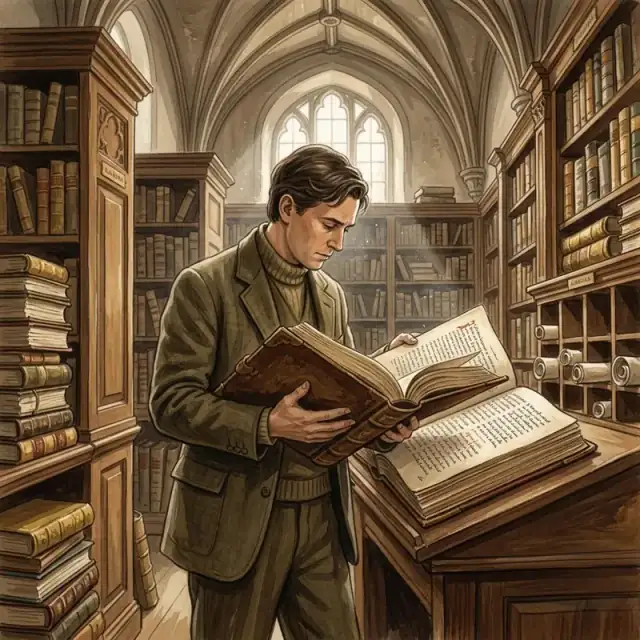
An adult stands in a quiet, grand archive, holding a heavy, ancient book with handwritten records.
The archive and the ancient, handwritten book represent the medieval world. It is a tangible link to a period of complexity and artistry that is often misunderstood in modern imagination.
Image credit: Wordspun · AI-generated conceptual illustration
Questions about this word
What does "Medieval" mean?
Medieval is adjective meaning: Relating to the Middle Ages; archaically old-fashioned.. Relating to the Middle Ages (roughly 500–1500 CE). Colloquially: very old-fashioned or primitive. The medieval world was not the dark ignorance of popular imagination — it was a world of remarkable complexity, faith, artistry, and violence.
Where does the word "Medieval" come from?
Latin: 'medium' (middle) + 'aevum' (age). A term invented in the 15th-century Renaissance to describe the period between classical antiquity and the Renaissance — implying a gap, a lesser time.