Longitude
noun /ˈlɒŋ.ɡɪ.tjuːd/ — Geographic distance east or west of the prime meridian.
Definition
The angular distance of a place east or west of the Greenwich meridian, expressed in degrees. Together with latitude, longitude provides a complete geographic location anywhere on earth. Longitude was the great unsolved problem of navigation for centuries.
Beyond the definition
The history of longitude is the history of a problem that killed sailors until it was solved. The inability to determine longitude at sea meant ships were always partly lost. Dava Sobel's account of its solution reads like a thriller.
Origin & history
Latin: 'longitudo' (length). From 'longus' (long). The geographic lines of longitude run vertically — along the length of the earth. Solving the 'longitude problem' (determining it at sea) was one of the 18th century's greatest scientific challenges.
Example sentences
Illustrative sentences for learning, not verified community posts or sourced quotations.
The ship was lost for three weeks before a reliable reading of longitude confirmed their position.
At zero degrees longitude, you are standing on the prime meridian in Greenwich.
John Harrison's marine chronometer solved the longitude problem — and changed navigation forever.
How to use it
This entry uses a noun. Follow the examples for articles and singular or plural forms; not every noun takes “a” or “an.”
Choose “Longitude” when the meaning fits your context: The angular distance of a place east or west of the Greenwich meridian, expressed in degrees. Together with latitude, longitude provides a complete geographic location anywhere on earth. Longitude was the great unsolved problem of navigation for centuries.
Synonyms
meridian, east-west position
Antonyms
Related words
Longitude vs latitude
Longitude is the horizontal coordinate used to define east-west position. Latitude is the vertical coordinate defining distance from the equator.
Word in the Wild
See how this word appears in life, language and stories.
Illustrative sentences and imagined stories for learning — not verified sightings, interviews, or sourced quotations.
Fictional scene
Observatory View of Planets and Stars
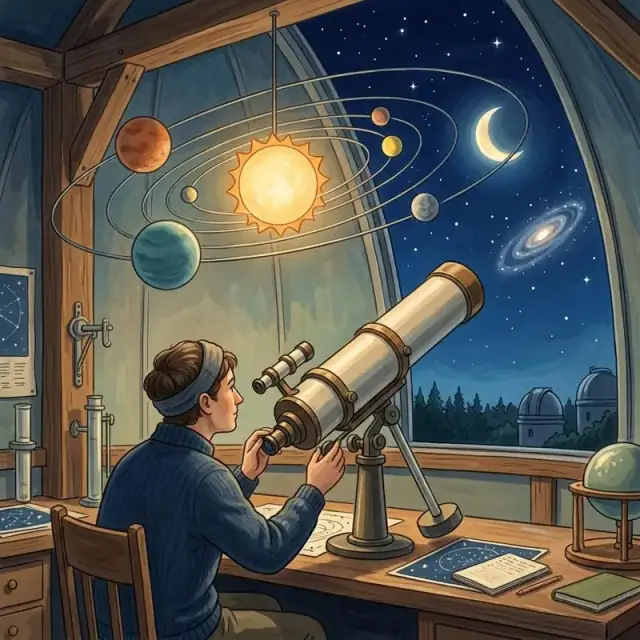
A simplified solar-system mobile with spherical planets on wires hangs above a desk, while a crescent moon and stars are visible through a window.
The arrangement of planets and orbits functions as an analogy for longitude. Just as maps use lines of longitude to fix a location on Earth, the astronomical model highlights the scientific necessity of determining precise points in a vast, coordinate-based system of movement and existence.
Image credit: Wordspun · AI-generated conceptual illustration
Questions about this word
What does "Longitude" mean?
Longitude is noun meaning: Geographic distance east or west of the prime meridian.. The angular distance of a place east or west of the Greenwich meridian, expressed in degrees. Together with latitude, longitude provides a complete geographic location anywhere on earth. Longitude was the great unsolved problem of navigation for centuries.
Where does the word "Longitude" come from?
Latin: 'longitudo' (length). From 'longus' (long). The geographic lines of longitude run vertically — along the length of the earth. Solving the 'longitude problem' (determining it at sea) was one of the 18th century's greatest scientific challenges.