Lacuna
noun /ləˈkjuːnə/ — A gap — a missing piece in a text, record, or understanding.
Definition
A gap or missing portion, especially in a manuscript, record, or account; an unfilled space; a blank.
Beyond the definition
Every map has its lacunae — the spaces labelled 'terra incognita' or left deliberately blank. A lacuna isn't just an absence; it's an absence in a record that should be complete. In memory, in history, in text: the lacuna marks what we know we're missing, which makes it different from ignorance. You can only name a lacuna if you know something should be there.
Origin & history
From Latin lacuna 'pit, hole, pool', related to lacus 'lake'. In classical scholarship, it refers to gaps in ancient manuscripts where text has been lost.
Example sentences
Illustrative sentences for learning, not verified community posts or sourced quotations.
There was a significant lacuna in his memory of that week — not blankness, but a shaped absence.
The historian noted the lacunae in the record: who destroyed those letters, and why?
Every map of that territory contained lacunae — places the cartographers couldn't or wouldn't name.
Synonyms
gap, blank, void, omission, hiatus
Antonyms
completeness, continuity, fullness
Related words
Word in the Wild
See how this word appears in life, language and stories.
Illustrative sentences and imagined stories for learning — not verified sightings, interviews, or sourced quotations.
Fictional scene
Tablets and blank parchment
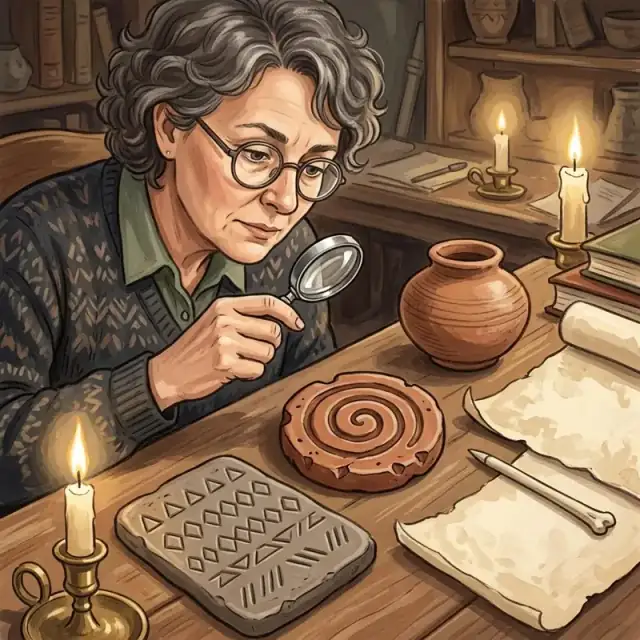
An archaeologist examines a seal and a geometric tablet on a desk, next to a partly unrolled piece of blank parchment.
The blank parchment is a literal lacuna—a missing portion in the record. It represents the unfilled space where information should be, symbolizing the gaps in our knowledge that the archaeologist is attempting to address through their research.
Image credit: Wordspun · AI-generated conceptual illustration