Kindergarten
noun /ˈkɪn.dər.ɡɑːr.tən/ — A school for young children — literally 'children's garden'
Definition
A school or class for very young children — typically ages 4–6 — that introduces them to social learning through play. The etymology reveals what education was meant to be: a garden for growing children.
Beyond the definition
Kindergarten's etymology is the most beautiful thing in education — the idea that children are seeds in a garden, and education is the tending, not the forcing. The word remembers what the institution sometimes forgets.
Origin & history
German: Kinder (children) + Garten (garden). Coined by educator Friedrich Fröbel in 1837 for his school in Blankenburg. His philosophy: children develop naturally through play, like plants in a garden.
Example sentences
Illustrative sentences for learning, not verified community posts or sourced quotations.
Friedrich Fröbel called it a kindergarten — a children's garden. The metaphor deserved to survive.
She returned from kindergarten each day having grown in ways that had nothing to do with letters.
The word kindergarten is a tiny manifesto about what childhood deserves.
How to use it
This entry uses a noun. Follow the examples for articles and singular or plural forms; not every noun takes “a” or “an.”
Choose “Kindergarten” when the meaning fits your context: A school or class for very young children — typically ages 4–6 — that introduces them to social learning through play. The etymology reveals what education was meant to be: a garden for growing children.
Synonyms
nursery school, preschool, early years education
Related words
Kindergarten vs preschool
Preschool is for children before age five. Kindergarten is typically the first formal year of compulsory school, acting as a bridge between play and structured learning.
Word in the Wild
See how this word appears in life, language and stories.
Illustrative sentences and imagined stories for learning — not verified sightings, interviews, or sourced quotations.
Fictional scene
Young Children Playing With Blocks
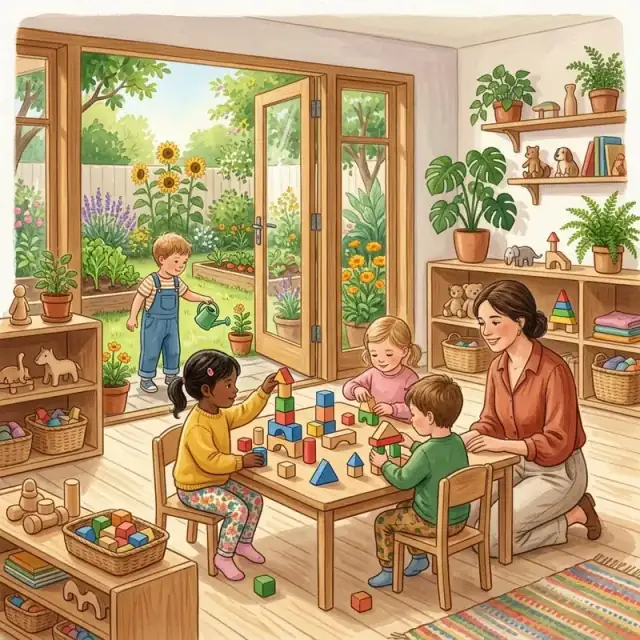
In a sunny classroom, young children play with colourful wooden blocks on the floor under the watch of an educator.
The setting captures the idea of a 'garden' for growing minds. By focusing on play-based learning and the social interaction of children in a safe, light-filled space, it illustrates the foundational intent of early education as a structured yet nurturing growth period.
Image credit: Wordspun · AI-generated conceptual illustration
Questions about this word
What does "Kindergarten" mean?
Kindergarten is noun meaning: A school for young children — literally 'children's garden'. A school or class for very young children — typically ages 4–6 — that introduces them to social learning through play. The etymology reveals what education was meant to be: a garden for growing children.
Where does the word "Kindergarten" come from?
German: Kinder (children) + Garten (garden). Coined by educator Friedrich Fröbel in 1837 for his school in Blankenburg. His philosophy: children develop naturally through play, like plants in a garden.