Haiku
noun /ˈhaɪkuː/ — A three-line Japanese poem — capturing a single moment in seventeen syllables.
Definition
A Japanese form of poetry consisting of three lines of five, seven, and five syllables, traditionally evoking images of the natural world and capturing a moment of heightened perception.
Beyond the definition
A haiku doesn't tell — it shows, then disappears. The seventeen syllables create a window, not an argument. After you read one, the feeling stays but the words let go. It's the most generous form: it gives you only enough to complete it yourself.
Origin & history
From Japanese haiku — a combination of hai (amusement, playfulness) and ku (phrase, verse). Originally the opening verse of a longer collaborative poem; Bashō elevated it to standalone art.
Example sentences
Illustrative sentences for learning, not verified community posts or sourced quotations.
'An old silent pond / A frog jumps into the pond / Splash! Silence again.' — Bashō's most famous haiku.
She wrote haiku at the end of difficult days — forcing her grief into seventeen syllables made it bearable.
The haiku doesn't explain; it arrives. The meaning belongs to the reader.
How to use it
This entry uses a noun. Follow the examples for articles and singular or plural forms; not every noun takes “a” or “an.”
Choose “Haiku” when the meaning fits your context: A Japanese form of poetry consisting of three lines of five, seven, and five syllables, traditionally evoking images of the natural world and capturing a moment of heightened perception.
Synonyms
brief poem, nature poem, imagist verse
Antonyms
epic, novel, long-form
Related words
Word in the Wild
See how this word appears in life, language and stories.
Illustrative sentences and imagined stories for learning — not verified sightings, interviews, or sourced quotations.
Fictional scene
Tree Seasonal Illustration
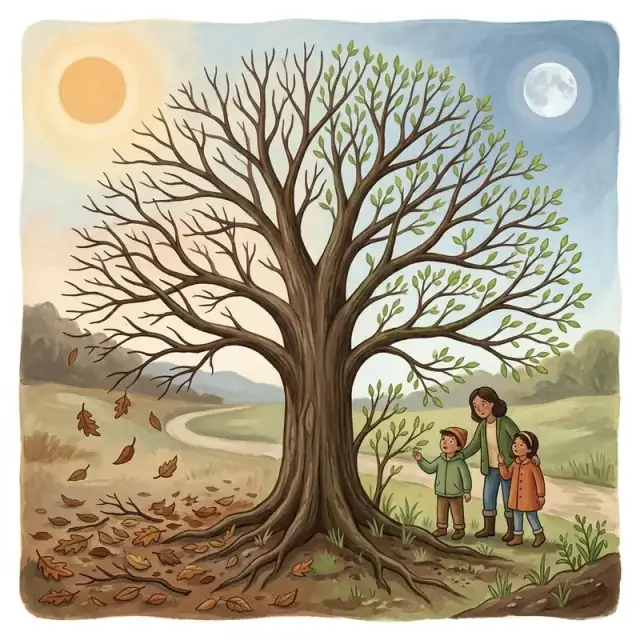
A botanical composition shows a tree with bare twigs on one side, budding leaves on another, and fallen brown leaves on the ground beneath.
A haiku is a three-line poem traditionally evoking the natural world and a moment of perception. The tree composition, showing different seasonal states in a single moment, mirrors this form, capturing the essence of the natural cycle in a concise, concentrated image that evokes a heightened perception of time and growth.
Image credit: Wordspun · AI-generated conceptual illustration
Questions about this word
What does "Haiku" mean?
Haiku is noun meaning: A three-line Japanese poem — capturing a single moment in seventeen syllables.. A Japanese form of poetry consisting of three lines of five, seven, and five syllables, traditionally evoking images of the natural world and capturing a moment of heightened perception.
Where does the word "Haiku" come from?
From Japanese haiku — a combination of hai (amusement, playfulness) and ku (phrase, verse). Originally the opening verse of a longer collaborative poem; Bashō elevated it to standalone art.