Evergreen
adjective / noun /ˈɛv.ə.ɡriːn/ — Retaining green leaves year-round; enduringly fresh and relevant.
Definition
Retaining green leaves throughout the year; not shedding leaves seasonally. Also: having an enduring freshness, success, or relevance. An evergreen song, an evergreen idea — one that does not age or become irrelevant.
Beyond the definition
The evergreen doesn't perform its survival. It simply continues. While the deciduous tree makes a drama of loss and renewal, the evergreen is quietly, consistently itself — unaffected by the season, permanently present.
Origin & history
English: 'ever' + 'green'. The botanical term was in use by the 17th century. The metaphorical use — of content or ideas that remain perpetually relevant — developed in the 20th century, especially in media.
Example sentences
Illustrative sentences for learning, not verified community posts or sourced quotations.
The pine stood evergreen through January's worst storms — still dark green against the grey sky.
Some books are evergreen — you return to them at different ages and they have different things to say.
Her grandmother had an evergreen quality: unchanged by decades in any way that mattered.
How to use it
Follow this entry’s examples for grammatical form and sentence placement.
Choose “Evergreen” when the meaning fits your context: Retaining green leaves throughout the year; not shedding leaves seasonally. Also: having an enduring freshness, success, or relevance. An evergreen song, an evergreen idea — one that does not age or become irrelevant.
Synonyms
Antonyms
Related words
Evergreen vs perennial
Evergreen refers to leaves staying green year-round. Perennial refers to a plant living for more than two years, regardless of its foliage cycle.
Word in the Wild
See how this word appears in life, language and stories.
Illustrative sentences and imagined stories for learning — not verified sightings, interviews, or sourced quotations.
Fictional scene
Tree Cycles of Decay and Life
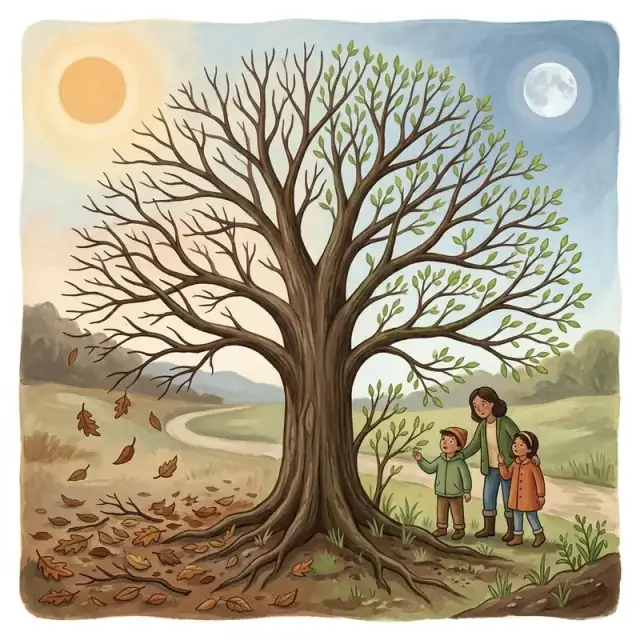
A tree with fallen brown leaves at its roots, bare twigs on one side, and budding green leaves on the other, under sunlight.
The tree acts as an evergreen idea: a conceptual representation of life that does not succumb to the limitations of a single season. By showing decay and growth simultaneously, it demonstrates enduring relevance—a cycle that refuses to age or become irrelevant regardless of the external conditions.
Image credit: Wordspun · AI-generated conceptual illustration
Questions about this word
What does "Evergreen" mean?
Evergreen is adjective / noun meaning: Retaining green leaves year-round; enduringly fresh and relevant.. Retaining green leaves throughout the year; not shedding leaves seasonally. Also: having an enduring freshness, success, or relevance. An evergreen song, an evergreen idea — one that does not age or become irrelevant.
Where does the word "Evergreen" come from?
English: 'ever' + 'green'. The botanical term was in use by the 17th century. The metaphorical use — of content or ideas that remain perpetually relevant — developed in the 20th century, especially in media.