Divination
noun /ˌdɪvɪˈneɪʃən/ — The practice of seeking knowledge of the future or the hidden by supernatural means.
Definition
The practice of attempting to discern hidden knowledge — future events, distant truths, the will of the divine — through signs, symbols, and ritual. From reading stars to reading cards, from augury to astrology, one of humanity's oldest practices.
Beyond the definition
Every culture has practised divination. It is not simply superstition — it is the deep human need to face uncertainty with some tool, however imperfect. The oracle, the tarot, the dream: all attempts to make the unknowable speak.
Origin & history
Latin 'divinatio' — from 'divinare' (to foresee, to be inspired by a god), from 'divinus' (divine). To divine is to access the divine perspective — to see what gods see.
Example sentences
Illustrative sentences for learning, not verified community posts or sourced quotations.
Ancient Rome ran on divination — augury, haruspicy, oracle consultation — all official state practice.
She used tarot less for divination than for structured reflection.
Divination is the poetry of uncertainty: a way of making the unknown tell a story.
Synonyms
Antonyms
empirical observation, rational analysis
Related words
Word in the Wild
See how this word appears in life, language and stories.
Illustrative sentences and imagined stories for learning — not verified sightings, interviews, or sourced quotations.
Fictional scene
Naturalist's workbench with fossils
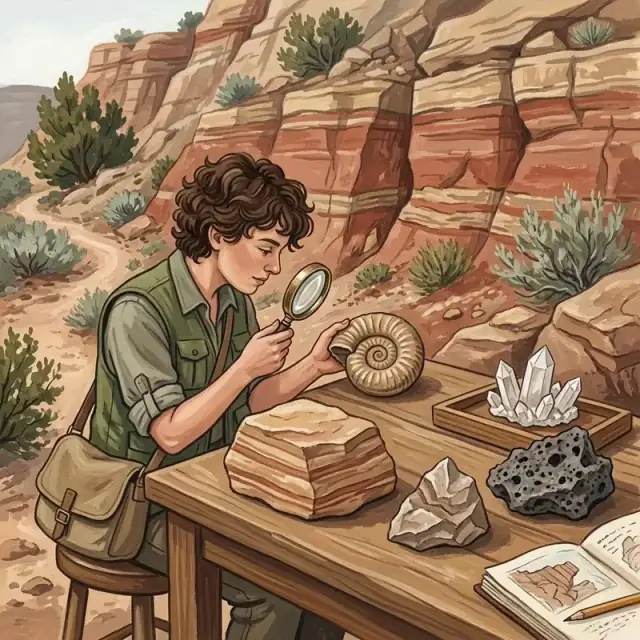
A naturalist’s bench features a layered stone, a spiral fossil, and quartz crystals next to a magnifying glass.
The naturalist examines these ancient geological records to discern distant truths about Earth's past, much like the practice of divination seeks to read signs. The interpretation of the fossil is a human attempt to extract hidden knowledge from a silent source.
Image credit: Wordspun · AI-generated conceptual illustration