Dissent
noun / verb /dɪˈsɛnt/ — The holding and expression of opinions at variance with those commonly held.
Definition
The holding or expression of opinions at variance with those commonly or officially held. To dissent is to refuse the offered consensus — to say: I have considered this and reached a different conclusion.
Beyond the definition
Dissent is courage at its most intellectual. It requires not just a different opinion but the willingness to voice it in a context where agreement is expected. The dissenter often pays a social cost; history usually vindicates them.
Origin & history
Latin: 'dissentire' (to disagree). From 'dis' (apart) + 'sentire' (to feel, to think). To think differently — to feel apart from the consensus. Related to 'sentiment' and 'sense'.
Example sentences
Illustrative sentences for learning, not verified community posts or sourced quotations.
She filed a formal dissent with the committee's findings — putting her name to her disagreement in writing.
Justice Ginsburg's dissents were famous: not just objections but arguments for a future court.
Healthy organisations make room for dissent. Unhealthy ones systematically eliminate it.
Synonyms
disagreement, opposition, nonconformity, objection
Antonyms
consent, agreement, conformity
Related words
Dissent vs sedition
Dissent is the expression of disagreement with an official position. Sedition is the active, illegal incitement of rebellion against that authority.
Word in the Wild
See how this word appears in life, language and stories.
Illustrative sentences and imagined stories for learning — not verified sightings, interviews, or sourced quotations.
Fictional scene
Hostility and Disagreement During Debate
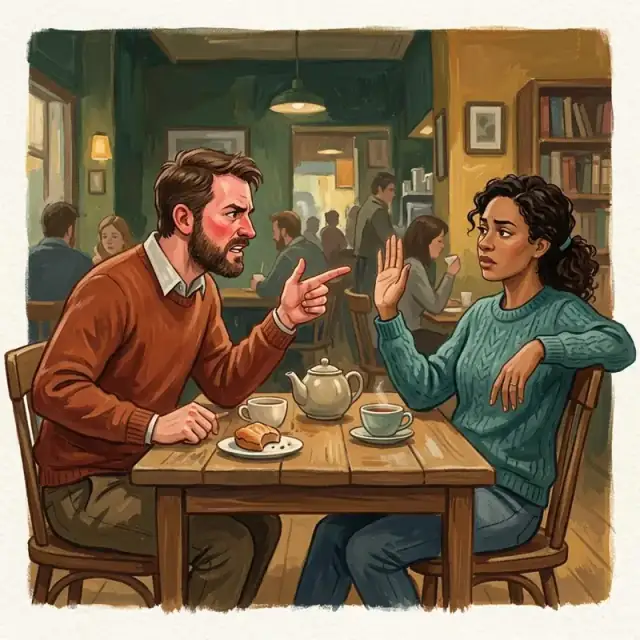
Two people at a table engage in a heated disagreement, with one making sharp, angry gestures and the other raising a hand for pause.
Dissent is the active rejection of a presented consensus. The clashing gestures illustrate the interpersonal friction occurring when an individual refuses an offered viewpoint to assert an alternative conclusion, highlighting the discomfort inherent in non-conformity.
Image credit: Wordspun · AI-generated conceptual illustration