Biome
noun /ˈbaɪ.əʊm/ — A large naturally occurring community of flora and fauna in a major habitat.
Definition
A large naturally occurring community of flora and fauna occupying a major habitat — such as tropical rainforest, tundra, grassland, or desert. Each biome has its own characteristic climate, plants, and animals, shaped over millions of years.
Beyond the definition
The biome is a world large enough to have its own rules. The rainforest is a biome — so is the Arctic tundra. Each is a complete universe of interdependence, worked out over geological time. We are its recent visitors.
Origin & history
Greek: 'bios' (life) + '-ome' (mass, collection). Coined by American ecologist Frederic Clements in 1916. Each biome is a mass of life organised by its characteristic conditions.
Example sentences
Illustrative sentences for learning, not verified community posts or sourced quotations.
The tropical rainforest biome holds over half of all the world's species on just six percent of its surface.
Climate change is shifting biomes northward — the taiga moving into tundra, the desert into grassland.
She had grown up in one biome and moved to its opposite — the desert after the ocean.
How to use it
This entry uses a noun. Follow the examples for articles and singular or plural forms; not every noun takes “a” or “an.”
Choose “Biome” when the meaning fits your context: A large naturally occurring community of flora and fauna occupying a major habitat — such as tropical rainforest, tundra, grassland, or desert. Each biome has its own characteristic climate, plants, and animals, shaped over millions of years.
Synonyms
Related words
Biome vs ecosystem
A biome is a large geographic area characterized by specific climate and life. An ecosystem is the interaction between organisms and their local physical environment.
Word in the Wild
See how this word appears in life, language and stories.
Illustrative sentences and imagined stories for learning — not verified sightings, interviews, or sourced quotations.
Fictional scene
Teeming Woodland Habitat Canopy
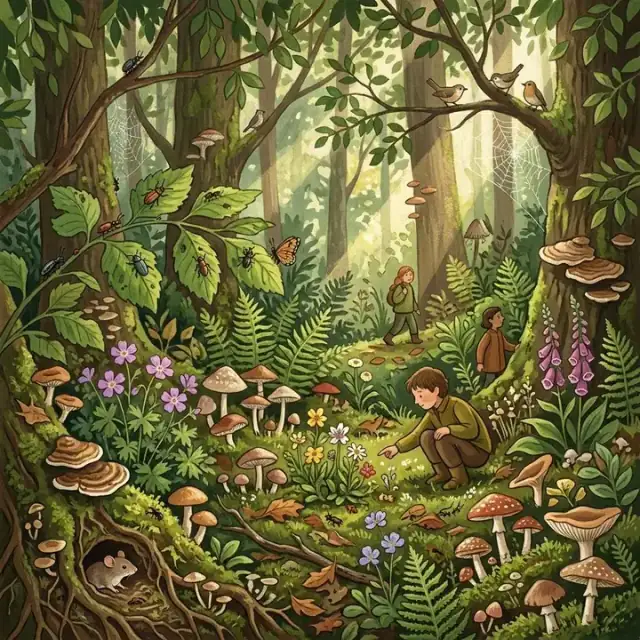
A dense, vibrant woodland scene where sunlight filters through a canopy onto a forest floor covered in diverse plants, leaves, and moss.
This woodland is a biome, a large, naturally occurring community shaped over millions of years. Its specific climate, plants, and animals function as a major habitat, representing the scale at which entire communities of flora and fauna exist in an integrated, characteristic environment.
Image credit: Wordspun · AI-generated conceptual illustration
Questions about this word
What does "Biome" mean?
Biome is noun meaning: A large naturally occurring community of flora and fauna in a major habitat.. A large naturally occurring community of flora and fauna occupying a major habitat — such as tropical rainforest, tundra, grassland, or desert. Each biome has its own characteristic climate, plants, and animals, shaped over millions of years.
Where does the word "Biome" come from?
Greek: 'bios' (life) + '-ome' (mass, collection). Coined by American ecologist Frederic Clements in 1916. Each biome is a mass of life organised by its characteristic conditions.