Alchemy
noun /ˈælkəmi/ — The ancient art of transformation — the pursuit of turning base matter into gold.
Definition
The medieval precursor to chemistry, which sought to transform base metals into gold, discover the philosopher's stone, and find the elixir of eternal life. As a metaphor: any process of profound transformation.
Beyond the definition
Alchemy failed at its stated goals but invented chemistry in the process. As a word, it carries something no other word quite does: the idea that transformation is possible, that the ordinary can become something rare, that there is a hidden process that changes everything.
Origin & history
Medieval Latin 'alchimia,' from Arabic 'al-kimiya' — possibly from Greek 'khemeia' (art of transmuting metals). The Arabic 'al' article attached itself permanently; 'chemistry' arrived later by removing it.
Example sentences
Illustrative sentences for learning, not verified community posts or sourced quotations.
There was an alchemy between them that their colleagues couldn't explain or replicate.
The editor performed a kind of alchemy on the manuscript — the same words, but transformed.
Cooking is alchemy: the raw becomes something entirely other.
Synonyms
transformation, transmutation, mysterious process
Antonyms
stasis, unchanged
Related words
Word in the Wild
See how this word appears in life, language and stories.
Illustrative sentences and imagined stories for learning — not verified sightings, interviews, or sourced quotations.
Fictional scene
Creating a smooth creamy emulsion
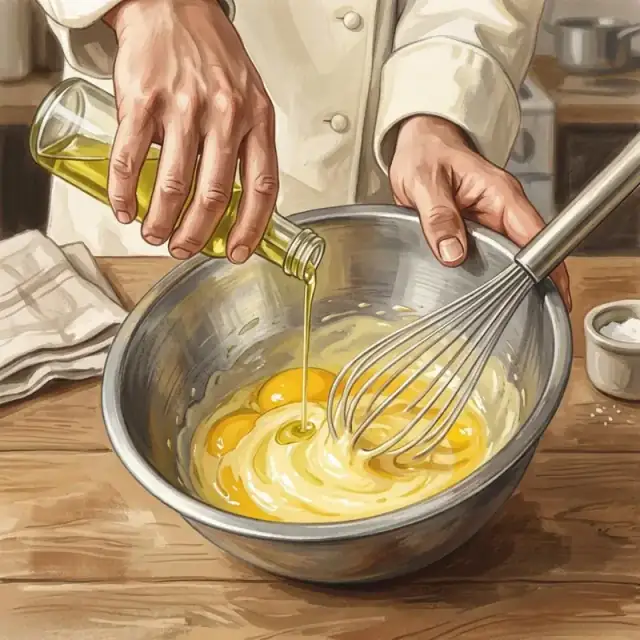
A hand drizzles oil into a whisked mixture in a metal bowl, transforming it into a smooth, creamy emulsion.
The transformation of separate ingredients into a single, cohesive substance is a culinary process of profound change. Like ancient alchemy, it illustrates how careful technique can combine base elements to create something entirely new and elevated in texture and quality.
Image credit: Wordspun · AI-generated conceptual illustration