Abstruse
adjective /æbˈstruːs/ — Difficult to understand; requiring significant effort to penetrate
Definition
Difficult to understand, requiring concentrated effort or specialist knowledge to penetrate — not obscure because hidden (like recondite) but demanding because inherently complex or deeply subtle.
Beyond the definition
The respect paid to difficulty. Abstruse ideas are not impossible — they simply require more of you. There is a pleasure in abstruse reading that is unavailable from easy reading: the satisfaction of having done the work to understand something that resists quick comprehension.
Origin & history
From Latin 'abstrusus' (hidden, secret, concealed) — past participle of 'abstrudere' (to push away, to conceal) — 'abs-' (away) + 'trudere' (to thrust). What has been thrust away from easy access. Related to 'intrude' and 'protrude'.
Example sentences
Illustrative sentences for learning, not verified community posts or sourced quotations.
The philosophy was abstruse but not impenetrable — it rewarded the reader who was willing to read each paragraph twice.
She had a gift for making the abstruse accessible without making it simple — the rarest skill in teaching.
There is a kind of beauty in abstruse argument: the pleasure of a form of thought that has been pushed as far as it can go.
Synonyms
Antonyms
simple, accessible, clear, lucid
Related words
Abstruse vs recondite
Abstruse describes abstract concepts that are inherently difficult for anyone to comprehend. Recondite describes subject matter that is little-known and hidden from general scholarly view.
Compare this word
Word in the Wild
See how this word appears in life, language and stories.
Illustrative sentences and imagined stories for learning — not verified sightings, interviews, or sourced quotations.
Fictional scene
Archaeologist Studying Geometric Tablet
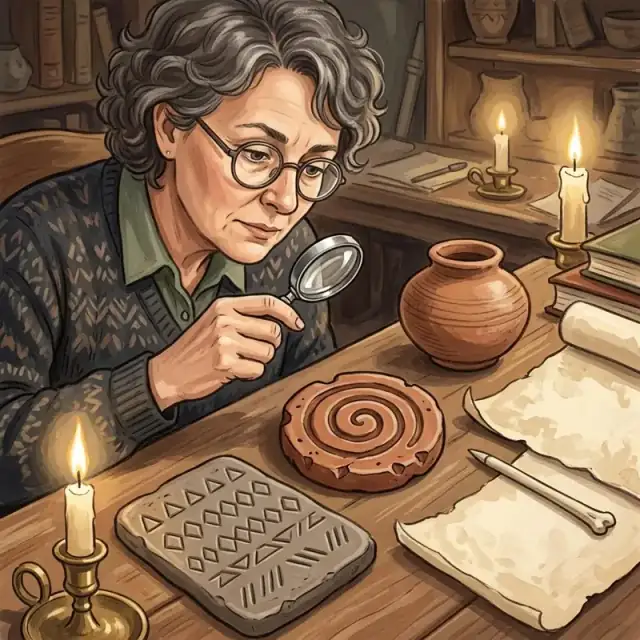
An archaeologist uses a magnifying glass to carefully analyze a clay tablet bearing only repeated, complex geometric shapes in a dimly lit room.
Abstruse knowledge is inherently difficult because it is deeply subtle or complex. The archaeologist's intense focus on the difficult-to-penetrate geometric patterns on the tablet illustrates this, as it requires specialized, concentrated effort to understand the meaning buried within the inherently complex and subtle structure of the object.
Image credit: Wordspun · AI-generated conceptual illustration